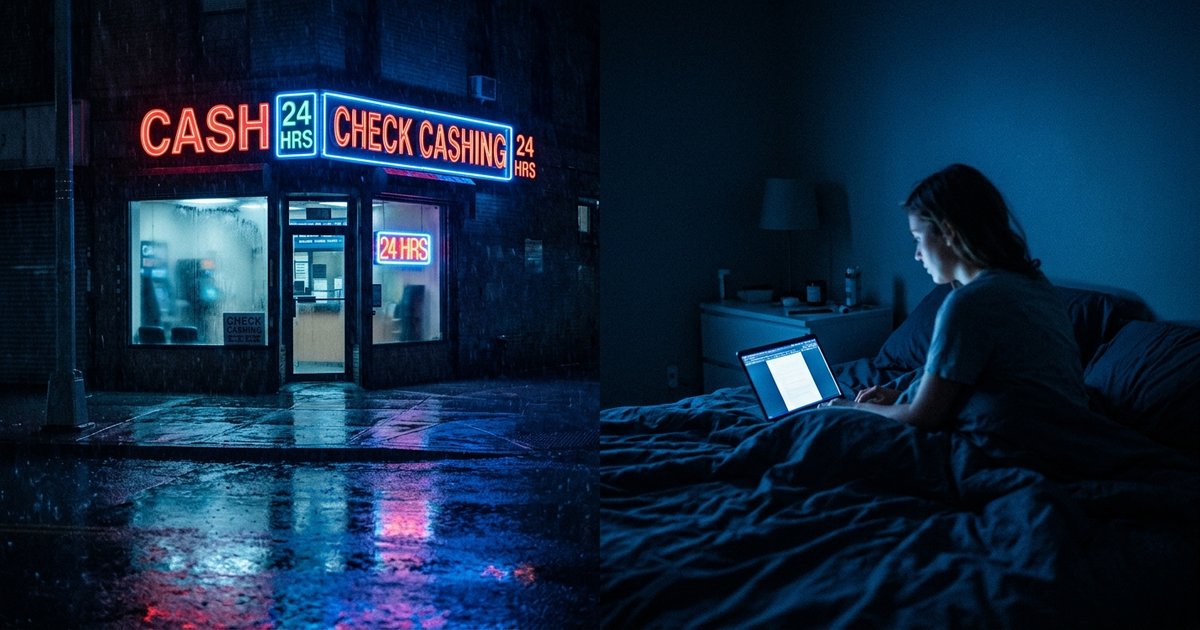


The pitch for online payday loans is built around one promise: funds in your account in minutes. The pitch for the storefront is built around the opposite: walk in, walk out with cash. Most consumer-facing comparisons treat the choice as a matter of convenience: do you want to drive somewhere, or do you want to swipe on your phone?
That framing misses the real difference. A CFPB Office of Research working paper published in March 2024 (Correia, Han, and Wang, "The Online Payday Loan Premium") found that online payday loans are contracted at a higher price than storefront loans, and that default risk is 2.6 to 8.4 percentage points higher for online borrowers. Earlier CFPB research found that half of online payday borrowers racked up an average of $185 in bank penalties from failed ACH debit attempts, and 36% of those borrowers had their checking account closed involuntarily as a result.
Storefront loans don't generate those bank penalty cascades the same way, because the repayment usually involves you bringing cash back to the store. The trade-off isn't speed versus convenience. It's speed versus recourse. Here is the actual decision frame.
The 2-Minute Decision Frame
Before you weigh costs, decide what you're optimizing for.
- If your goal is speed and you accept the risk to your bank account: online wins. Funding can land in your checking account within minutes to a few hours during business days, faster than you can drive to most stores.
- If your goal is the strongest legal protection and the lowest chance of your bank account getting drained on payday: storefront wins. You apply in-state, the lender is licensed in your state, the repayment is a cash transaction at the counter, and your bank account is never exposed to a repeated ACH debit cycle.
Speed has a price. The CFPB's online premium research quantified it for the first time in 2024, and the numbers favor the storefront on cost as well as on risk. For a head-to-head on the three biggest brands in this category, see Speedy Cash vs Advance America vs CashNetUSA.
The Online Premium: What the CFPB Research Actually Found
The Correia, Han, and Wang working paper compared loans from the same lenders making both online and storefront loans. Same brand, same borrower profiles where comparable, different channel. The online channel cost more per loan, and the borrowers defaulted more often.
The default-risk gap of 2.6 to 8.4 percentage points may sound abstract; in practice it means that for every 100 online borrowers, two to eight additional borrowers default compared to a comparable group of storefront borrowers. That increased default risk is priced into the loan from day one.
Two reasons for the gap, both supported by CFPB data and lender disclosures:
- Online underwriting is automated and faster, so it catches less. The trade-off the lender makes for funding in minutes is taking on borrowers who would have been declined in the slower storefront process.
- The ACH repayment mechanic creates a feedback loop. When the ACH fails on payday, the borrower owes the lender plus owes the bank an NSF fee. The next paycheck has to cover both. The cycle compounds.
The ACH Problem That Storefronts Don't Have
Online payday loans run on ACH (Automated Clearing House) authorization. You sign over your routing number and account number, give the lender permission to debit on the due date, and the system runs on payday.
When the debit succeeds, the loan is repaid and the loop closes. When the debit fails (the paycheck didn't land, another bill cleared first, the balance was a few dollars short), things cascade. The CFPB found:
- 50% of online payday borrowers in the sample incurred bank penalties from failed debit attempts.
- The average penalty exposure was $185.
- 36% of borrowers who incurred a penalty had their checking account closed involuntarily by the bank.
- When lenders submit multiple same-day debit attempts: 76% all succeed, 21% all fail (you get hit with an NSF on each), 3% partially fail.
The CFPB's 2017 Payday Lending Rule's payment provisions, which finally took effect on March 30, 2025 after years of litigation, limit lenders to two consecutive failed debit attempts on the same authorization before they have to obtain a new one from you. That's progress, but it doesn't stop the first two strikes from triggering bank fees. The structural fix is in bank accounts with no overdraft fees.
You have a federal right under Regulation E to revoke ACH authorization in writing at any time. If you sense your paycheck won't cover the lender's pull, email the lender to revoke and follow with a written notice to your bank. The lender then has to find another way to collect, usually a phone call. That's a worse outcome for the lender and a better one for your bank balance.
Storefront loans avoid most of this because repayment is a cash transaction. You walk in on the due date, pay the loan, and the lender never touches your bank account. The harms the CFPB documented are specific to the ACH channel.
The Tribal Lender Trap
This is the risk that's unique to online payday lending and that storefront borrowers almost never encounter. A tribal lender asserts affiliation with a Native American tribe and claims sovereign immunity from state usury caps and consumer protection laws. APRs commonly range from 400% to 900%, with some installment products quoted higher.
The legal status is contested. The Supreme Court's framework from Michigan v. Bay Mills (2014) still controls the immunity analysis, and federal circuits have split on the enforceability of tribal arbitration clauses. ProPublica's investigative reporting has documented the "rent-a-tribe" model, where non-tribal financiers operate the lending business and pay the tribe a fee to use its name. The pattern overlaps with several of the schemes mapped in our payday loan scams piece.
Spotting one before you sign:
- The lender's name references a tribe, "First Nation," or a Native-themed brand element.
- The loan agreement says it's "governed by [Tribe Name] law" or "subject to the laws of [Tribe Name]."
- Disputes are resolved in a tribal arbitration forum, not in your state court.
- The APR is well above what your state allows for licensed lenders.
If you live in a state with a 36% APR cap and the lender is quoting 450% online, the lender is either operating illegally in your state or claiming a tribal exemption your state attorney general may not honor. Either way, your recourse if something goes wrong is harder to access than it would be with a state-licensed storefront.
Verifying a Lender's License in 60 Seconds
This is the single most useful habit for any payday borrower. Before you sign, check:
- Open your state's Department of Financial Institutions or banking regulator's website.
- Find the licensee search. Most states call it "licensee lookup" or "verify a license."
- Type the lender's legal entity name (not the brand). Confirm they're listed as licensed in your state.
- For multistate lenders, also check NMLS Consumer Access.
If the online lender isn't in the database, you don't have state-law recourse. That's not the same as saying the loan is illegal; it usually means the lender is operating across state lines under a different legal theory (often tribal). It means your state attorney general has limited tools to help you if the relationship goes sideways.
Who Should Pick Storefront
- You live within reasonable driving distance of a licensed storefront lender (Advance America, Speedy Cash, Check Into Cash, Check 'n Go, ACE Cash Express in your state).
- You can pay the loan back in cash at the counter on the due date.
- Your bank account has limited cushion and you can't risk an NSF cascade.
- You want the option to walk back in and renegotiate face to face if things change.
- You value the CFSA-required extended payment plan (offered by member lenders) as a safety net.
Who Should Pick Online
- You don't have storefront access in your state or your area.
- You verified the lender is licensed in your state (not a tribal lender claiming exemption).
- You can repay reliably from your next paycheck, with a comfortable buffer in your checking account.
- You understand your Regulation E right to revoke ACH authorization in writing if needed.
Who Should Pick Neither
The honest list:
- If you're already in a rollover cycle from a previous payday loan, another loan extends the cycle. See breaking the rollover cycle instead.
- If your repayment plan involves taking out a second loan to pay the first one back, the math runs against you fast.
- If you're an active-duty service member or covered dependent, the Military Lending Act caps your effective APR at 36%, which most payday products exceed. Most large lenders won't lend to MLA-covered borrowers for that reason. The civilian gap is covered in the MLA explainer.
- If you could realistically wait one to three business days, an employer-sponsored EWA benefit (DailyPay, Payactiv, Even) is often free.
- If you're a credit union member, a Payday Alternative Loan (PAL) capped at 28% APR is structurally cheaper than any payday product. See our PAL guide.
The Three Alternatives Worth Trying First
- NCUA Payday Alternative Loan (PAL). $200 to $2,000, terms of one to 12 months, APR capped at 28%, modest application fee. Requires federal credit union membership, usually one month minimum. The math beats payday by a wide margin on any loan size.
- Employer-sponsored EWA. If your employer offers earned wage access through a payroll partner, the cost is often zero. Worth checking with HR before you do anything else.
- Direct call to the biller. Utilities, landlords, medical providers, and many subscription services will defer or split a payment for free if you ask before the due date. A payday loan to pay a bill that the biller would have deferred is the most expensive mistake in this category.
Frequently Asked Questions
Are online payday loans legal in my state?
It depends on your state and the specific lender. Some states allow online payday lending under the same rules as storefronts; others ban payday lending entirely; some allow it only from in-state licensees. Check your state Department of Financial Institutions licensee lookup before you apply. If the lender isn't on the list, you don't have state-law recourse.
Can a tribal lender garnish my wages?
Not without a court judgment. Tribal lenders, like any lender, can't garnish wages without suing and winning. The harder question is which court hears the suit; many tribal loan agreements require arbitration in a tribal forum, which can limit your defenses. State attorneys general have successfully challenged some tribal lender collection actions; others have stuck.
How do I stop an online lender from debiting my account?
Revoke the ACH authorization in writing to the lender (email is fine, keep a copy), then file a stop-payment order with your bank. Under Regulation E, you have the right to revoke. The bank can charge a stop-payment fee, typically $20 to $35, which is still usually cheaper than another NSF cascade.
Is "instant funding" actually faster than a storefront?
Sometimes. Online "instant" funding through a debit card push can land in your account in minutes during business hours, faster than driving to a store. Standard ACH funding takes one business day, sometimes two over weekends. A storefront in the next strip mall, paying in cash, beats both.
What happens if I default on a tribal loan?
The lender will attempt collection through normal channels (ACH attempts, calls, eventual placement with a collection agency). Some tribal lenders file in tribal arbitration; some pursue lawsuits in federal court. The Fair Debt Collection Practices Act applies to third-party collectors regardless of the original lender's tribal status. Damage to your credit through bureau reporting and collection account placement is the most common consequence.
Are online lenders required to follow the Military Lending Act?
Yes. The MLA's 36% Military Annual Percentage Rate (MAPR) cap applies to consumer credit extended to active-duty service members and covered dependents, regardless of whether the lender is online, storefront, or tribal. Most payday products exceed 36% MAPR, so most lenders simply won't lend to covered borrowers and screen for MLA status during application. If you're MLA-covered and a lender approved you at a 300% APR, that's a violation worth reporting to the CFPB.