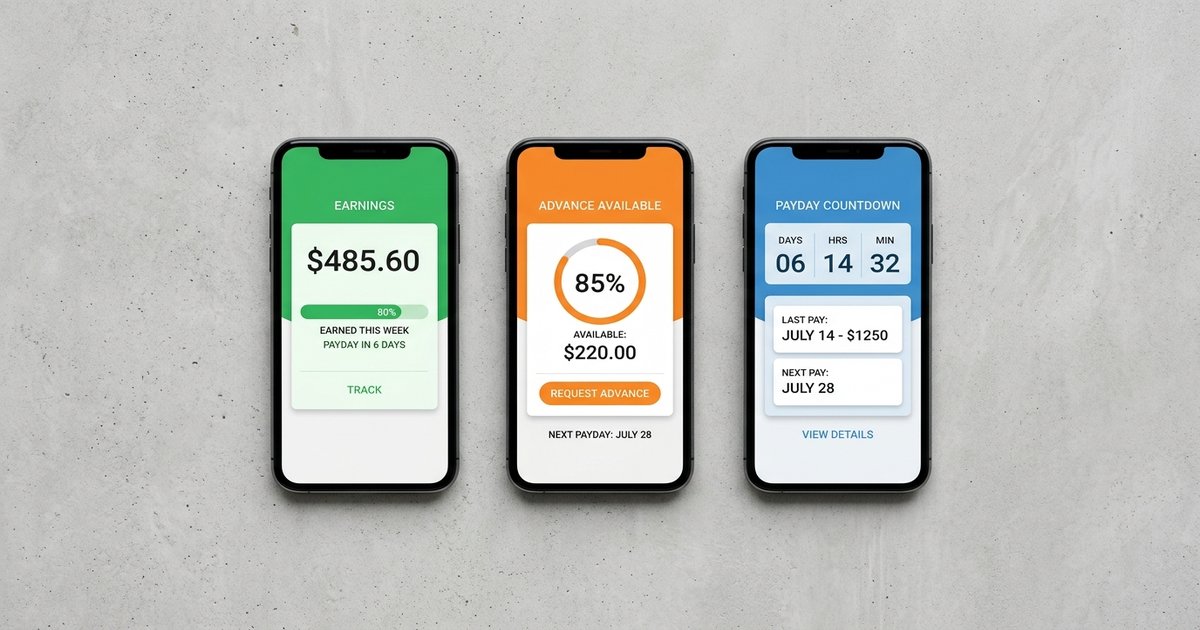



Open EarnIn, Dave, or MoneyLion and the first thing you'll see is some version of the same promise: free advances, no interest, no credit check. None of those statements are technically false. They also don't survive contact with a calendar.
The CFPB's own data on the paycheck advance market found that the average user takes 27 advances per year, and once you include "optional" tips and expedited funding fees, the typical APR on employer-partnered earned wage access (EWA) products is 109.5%. On direct-to-consumer apps (the category EarnIn, Dave, and MoneyLion all fall into), APRs north of 350% are common. Those numbers come from the CFPB's July 2024 Data Spotlight, the most authoritative public source on the category.
Here is how the three biggest EWA apps actually charge you, what the December 2025 CFPB advisory opinion did to the federal rulebook, and which app is the cheapest choice for your specific pattern of use.
How Each App Actually Makes Money
The mechanics matter because the apps make money in different places. If you only ever take the slow, free version of an advance, you'll pay close to nothing. The fee structure is built around the fact that most users won't wait.
EarnIn charges nothing for a standard advance that lands in your account in one to three business days. The revenue comes from Lightning Speed, the expedited delivery option, which runs $1.99 to $3.99 per advance per EarnIn's own help center, and from optional tips. A $100 advance with a $3.99 Lightning Speed fee, repaid in two weeks, pencils to roughly 145% APR. That figure comes directly from the Pennsylvania federal class action complaint that survived EarnIn's motion to dismiss in 2024.
Dave has more moving parts. There's a $1 monthly membership fee (some tiers run $3 or $5), a service fee of 5% of the advance with a $5 minimum and a $15 maximum, and a 1.5% express fee if you want the money sent to an external debit card (free to a Dave Checking account). A $200 advance with the standard 5% service fee costs $10 every time you take it.
MoneyLion charges a turbo fee for instant Instacash delivery: $0.49 to $6.99 to a RoarMoney account or $1.99 to $8.99 to an external bank, per Bankrate's review of the current schedule. RoarMoney itself carries a $1 monthly admin fee. Credit Builder Plus, which some users sign up for to raise their Instacash limit, is $19.99 per month.
The Side-By-Side, $100 Advance, 14 Days
Here's what a $100 advance actually costs across the three apps if you want the money today rather than next week. These numbers were verified against each app's published fee page; check the live page on the day you sign up.
- EarnIn: $3.99 Lightning Speed fee, no mandatory tip. Effective APR around 104% on a 14-day term. If the in-app prompt nudges you into a $2 tip, the cost rises to $5.99 and the APR roughly doubles.
- Dave: $5 minimum service fee (the 5% on $100 would be $5), plus the $1 membership amortized across the month, plus $1.50 express fee to an external card. Call it $7.50 for the advance. Effective APR around 196% on a 14-day term.
- MoneyLion: Turbo fee around $3.99 to an external bank for a $100 advance, plus the $1 monthly RoarMoney admin fee if you went that route. Around $4 to $5 in real cost. Effective APR roughly 104% to 130%.
For a single $100 advance, EarnIn and MoneyLion are roughly tied at the bottom. Dave costs the most per advance at the small end because the service fee has a $5 floor; the math gets better for Dave at larger advance sizes, where the 5% rate is less brutal than EarnIn or MoneyLion's flat expedite fees. If APR-style math feels abstract, the payday APR explainer shows exactly how a small fee annualizes into a big number.
Where the "Free" Claim Breaks
The fee math above assumes you take an advance once. Almost nobody does. The CFPB sample found that about one in three EWA users reborrowed within two weeks, and 27 advances per year was the average across employer-partnered users; direct-to-consumer users typically take even more.
At 27 advances per year on EarnIn, paying the $3.99 Lightning Speed fee each time, you're spending $107.73 annually on access to your own money. On Dave with a $5 minimum service fee plus the $1 monthly membership, the same 27 advances cost $147. On MoneyLion at a $4 average turbo fee plus the $12 annual RoarMoney admin, you're at roughly $120.
That's the structural problem. None of these apps charge interest in the traditional TILA sense. All of them generate real money from people who use them often, which is most users.
The December 2025 CFPB Reversal
On December 23, 2025, the CFPB issued an advisory opinion stating that qualifying employer-partnered EWA products are not "credit" under the Truth in Lending Act, and rescinded the Biden-era July 2024 proposed rule that would have treated tips and expedite fees as finance charges. The advisory was published in the Federal Register that day.
What this means for you, the user: federal APR-style disclosures on these apps are off the table for now. The burden is on you to do the math from the fee schedule. State action is still very much alive. California's DFPI has memoranda of understanding with EarnIn, MoneyLion, Dave, and Brigit; Connecticut and Maryland have ruled EWA products are loans subject to small-loan licensure; Nevada and Missouri have passed dedicated EWA statutes; and the D.C. Attorney General's 2025 lawsuit against EarnIn (alleging the "no interest" marketing misled about 20,000 D.C. residents) is ongoing. EarnIn also lost a motion to dismiss in a Pennsylvania federal class action in 2024 on the theory that tips and Lightning Speed fees function as disguised interest under state usury law.
None of that has been resolved. But the lawsuits exist for a reason, and they line up with what borrowers say in the reviews: "It's not the fee, it's that I'm using it every pay period now."
Which App Is Cheapest for Which User
The honest answer depends on how often you use these tools and how patient you can be.
- One-off emergency, can wait two business days: All three are functionally free if you take the slow option. Use whichever is already installed.
- One-off emergency, need it now: EarnIn at the Lightning Speed fee is usually the cheapest single-advance option on a small amount. MoneyLion is competitive. Dave costs more on small amounts because of the $5 service fee floor.
- Larger advance ($300 to $500), need it now: Dave's 5% service fee (capped at $15) becomes the better deal because it doesn't scale linearly. On a $500 advance, Dave's $15 plus express fee can beat EarnIn or MoneyLion's flat expedite fee on certain tiers.
- Monthly cushion (you'll use it every paycheck): Look hard at whether your employer offers a free EWA benefit through a payroll partner. If they do, that's the cheapest option, full stop. If they don't, run the annual math on each app and pick the lowest number; for most patterns that's EarnIn or MoneyLion.
- Weekly habit: The honest advice is that you've outgrown the product. A Payday Alternative Loan (PAL) from a federal credit union, capped at 28% APR with terms of one to 12 months, is structurally cheaper than 27 EWA advances per year, even if it feels like a bigger commitment up front. We map the PAL workaround in our PAL explainer.
Cheaper Alternatives, Ranked
Before you make EWA a permanent line in your budget, consider:
- Employer-sponsored EWA through a payroll partner like DailyPay, Payactiv, or Even, where your employer covers the fees. If it's available to you, it's almost always free or close to it.
- NCUA Payday Alternative Loan (PAL), capped at 28% APR, $200 to $2,000, requires one month of credit union membership in most cases. Far cheaper than repeated EWA advances if you need money regularly.
- Credit union small-dollar loan. Many federal and state-chartered credit unions offer small-dollar products outside the PAL framework that beat EWA pricing on anything more than an occasional advance.
- A structured cash-flow buffer. If your income moves week to week, see how to budget on irregular income: a two-account system can absorb most of what people use EWA for.
Frequently Asked Questions
Is EarnIn the same as a payday loan?
Legally, no, at least according to the CFPB's December 2025 advisory opinion. Functionally, the fee math on a frequent user looks similar to a low-end payday product. The D.C. Attorney General and a Pennsylvania federal class action are both arguing that the tip and Lightning Speed mechanics resemble interest under state usury law. That question is unresolved.
Does using Dave, EarnIn, or MoneyLion hurt my credit score?
None of the three reports advances to the major credit bureaus as traditional credit accounts, so taking an advance won't show up on your FICO. Late or unpaid advances can still hit you through bank overdrafts, collections referrals in some cases, and (for MoneyLion's Credit Builder Plus) installment loan reporting that does affect credit.
What happens if my paycheck doesn't cover the EWA repayment?
The app pulls when your direct deposit hits. If the funds aren't there, the ACH can fail, your bank can charge an NSF or overdraft fee, and the app may try again. EarnIn has been the subject of complaints about repeated debit attempts; revoke the ACH authorization in writing if you need to stop the pulls under Regulation E.
Can these apps overdraft my account?
Yes, indirectly. If the repayment pull hits before another scheduled debit clears, your bank can charge overdraft fees on the cascade. Some users have reported $30 to $100 in bank penalties triggered by an EWA repayment timing mismatch. Watch your account in the 24 hours after payday, and consider a checking account that can't charge overdraft fees.
Which EWA app actually has zero fees if I'm patient?
All three offer a free standard transfer if you wait one to three business days. EarnIn's standard delivery is free. Dave's advance can be free if you accept slow delivery to a Dave Checking account and skip the express option, though the $1 membership fee still applies. MoneyLion Instacash is free for slow delivery (one to five business days) to an external bank.
Are tips really optional?
Yes, technically. The D.C. Attorney General's 2025 lawsuit against EarnIn alleges the user interface uses dark patterns to push users toward tipping, including default tip amounts and friction when setting the tip to zero. You can decline. You may have to dig for the option.